Search Results for "sims 4 record player cc"
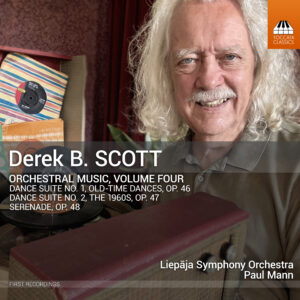
Derek B. Scott: Orchestral Music, Volume Four
Derek Scott, born in Birmingham in 1950, has a long history of engagement with the British music hall and other forms of light entertainment, as both historian and performer. Many of his own compositions attest to this interest in popular styles, with his craftsmanship and natural feeling for a good tune producing music of immediate appeal. One of his two recent Dance Suites takes its cue from ska, the twist and other enthusiasms from the early 1960s, and the other from older dance favourites. Time was when works like Arthur Benjamin’s Jamaican Rumba and Percy Faith’s arrangement of Alfvén’s Swedish RhapsodyNo. 1 could be heard on every domestic radio and record-player; these good-natured Dance Suites recapture some of that lost innocence and its relaxed energy – but his Serenade, another recent composition, touches gently on deeper feelings.
Liepāja Symphony Orchestra
Paul Mann, conductor
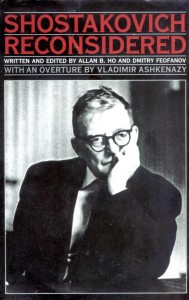
Shostakovich Reconsidered
With an overture by Vladimir Ashkenazy
Extent: 791 pages
Composition: Demy octavo ~ Illustrated ~ Appendices ~ Bibliography ~ Index
Illustrations: 16 b/w
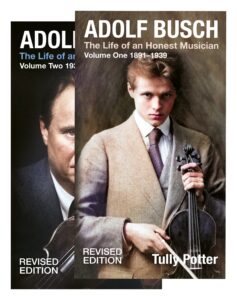
Adolf Busch: The Life of an Honest Musician – Two Volume Revised Edition Set
Volume 1: 1891–1939
Volume 2: 1939–1952; Appendices 1–12
Includes two CDs: Busch the Performer; Busch the Composer
Extent: 1432 pages
Composition: Royal octavo, 2 vols of 702 & 730 pp.
255 b/w illus.
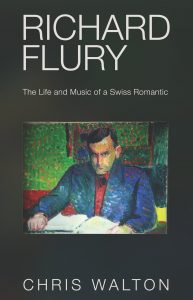
Richard Flury: The Life and Music of a Swiss Romantic
Author: Chris Walton
Extent: 328 pages
Size: 16 x 24 cm
Published: March 2017
Illustrations: 22 colour illustrations; 51 b/w illustrations
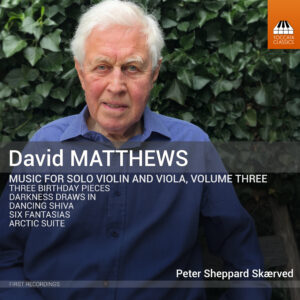
David Matthews: Music for Solo Violin and Viola, Volume Three
David Matthews and Peter Sheppard Skærved have been collaborating on a series of works for violin and viola for many years now, with Matthews setting Sheppard Skærved formidable technical challenges, and Sheppard Skærved surprising Matthews by finding a way to overcome the difficulties in his path. Behind all the pyrotechnics, this partnership is generating one of the largest, and most musically rewarding, body of compositions for violin and viola by any living composer. Many of Matthews’ pieces record his experience of nature or offer tributes to friends, with the works heard in this third volume also tracing a journey from darkness to light.
Peter Sheppard Skærved, violin and viola
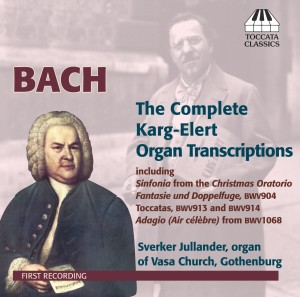
Bach: The Complete Karg-Elert Organ Transcriptions
During his lifetime the Leipzig-born Sigfrid Karg-Elert (1877-1933) was a well-known harmonium player and pianist. It was his organ music that made him internationally famous as a composer, especially in Britain and the USA. Today, too, his own organ music is frequently recorded and heard in recitals, but his many organ transcriptions are less familiar. After Wagner, Bach was the composer whose music Karg-Elert transcribed most often, carefully choosing the pieces best suited to the dynamic and colouristic possibilities of the late Romantic organ.
Sverker Jullander, organ
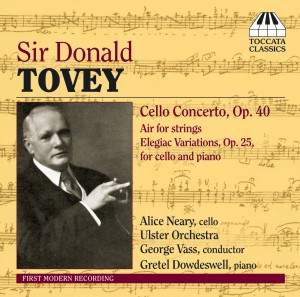
Sir Donald Tovey: Cello Concerto, Air for strings, Elegiac Variations
Donald Tovey (1875–1940) has long been known as one of the finest writers on music in English – but he saw himself primarily as a composer. His Cello Concerto – written for his friend Pablo Casals in 1932-33 – may be the longest in history; indeed, as he worked on the score he wrote to a friend that the first movement would be a 'record-breaker’ and 'much the juiciest’ music he had yet produced. The work sits mid-way between Brahms and Elgar, but has a lyrical and dignified voice that is uniquely Tovey’s. The contrasting tone of the dark, heroic Elegiac Variations was inspired by the death of Robert Hausmann, cellist of the Joachim Quartet and a cherished chamber-music partner of Tovey’s. And the charming Air for strings reveals his delight in a well-turned Classical theme.
Alice Neary, cello
Ulster Orchestra, orchestra
George Vass, conductor
Gretel Dowdeswell, piano
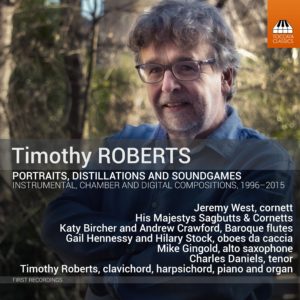
Timothy Roberts: Portraits, Distillations and Soundgames
Timothy Roberts, born in Hampstead, north London, in 1953, has been a mainstay of the early-music scene in Britain and further afield for decades. He is best known as a keyboard player, but in recent years composing has been of growing importance to him. Hardly surprisingly, his music refracts the Baroque and Classical world in which he is active, usually with a playful but respectful twist.
Jeremy West, cornett (tracks 1–13, 17–23)
Timothy Roberts, harpsichord (tracks 2–15), piano (tracks 11–16), clavichord (track 14), organ (track 22)
His Majestys Sagbutts & Cornetts (tracks 5–10)
Katy Bircher and Andrew Crawford, Baroque flutes (tracks 18–21)
Gail Hennessy and Hilary Stock, oboes da caccia (tracks 18–21)
Mike Gingold, alto saxophone (track 24)
Charles Daniels, tenor (track 27)
Digital compositions (tracks 24, 26–28)
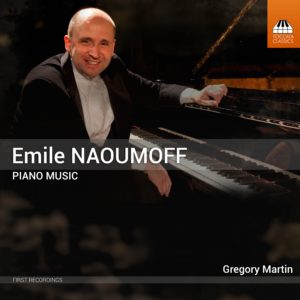
Émile Naoumoff: Complete Piano Music
Emile Naoumoff, born in Sofia in 1962, was a child prodigy as pianist and composer in his native Bulgaria but was soon taken under the wing of Nadia Boulanger in Paris – ‘the gift of my old age’, she said. Naoumoff himself has tended to record the music of other composers, and so this recital of his piano music has been recorded by Gregory Martin, who has worked with him in various capacities. It presents music from across Naoumoff’s career – from that gifted childhood to a piece inspired by the sight of Notre Dame Cathedral in flames in 2019 – absorbing influences from Slavic folk-dance to Gabriel Fauré, whose ‘grand-student’ he is.
Gregory Martin, piano
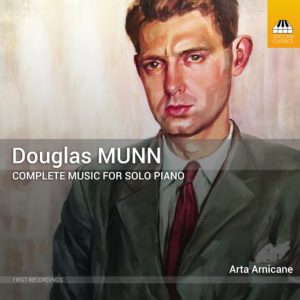
Douglas Munn: Piano Music
The man who as W. D. Munn published papers on that branch of mathematics known as semigroup theory had another side to his personality: Douglas Munn (1929–2008), professor of mathematics at the University of Stirling, was also a fine pianist and a gifted composer. His piano music has its origins in Chopin, Brahms and Bartók but is clearly also inflected by Scottish folksong – much of it has a sense of the hills and the open spaces – and is written by someone with an intimate knowledge of the instrument. The Latvian pianist Arta Arnicane knew Douglas Munn and this album is the fulfilment of an unspoken promise to record his piano music.
Arta Arnicane, piano
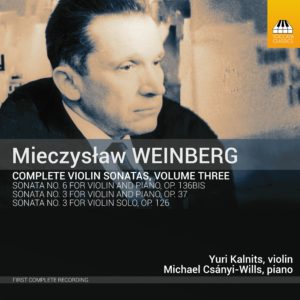
Mieczysław Weinberg: Complete Violin Sonatas, Volume Three
If Mieczysław Weinberg had lived for another decade or so after his death in 1996, he would have seen his status change from poorly known outlier to general acceptance as one of the major twentieth-century composers. His violin works have likewise been recognised as major additions to the repertoire. Since Yuri Kalnits and Michael Csányi-Wills began what will be a four-volume survey of Mieczysław Weinberg’s music for violin and piano, other musicians have discovered and recorded many of these masterworks, but on its completion this cycle will still be the first to record all of Weinberg’s violin works.
Yuri Kalnits, violin
Michael Csányi-Wills, piano
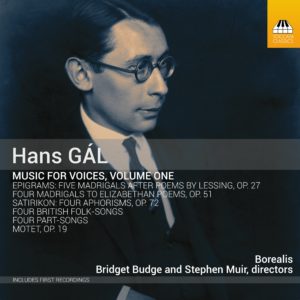
Hans GÁL: Music for Voices, Volume One
Whether in his original home of Vienna, as a conservatoire director in Germany, or as an émigré in Edinburgh, where he became one of the mainstays of musical life, Hans Gál (1890–1987) championed choral singing as a way of directly involving people in making music: he founded and conducted a number of choirs and provided an extensive output of choral compositions. This first volume in a long-term project to record his choral music presents a rich variety of works for a cappella voices, ranging from demanding eight-part choruses to charming folksong settings.
Borealis
Bridget Budge (1 –14, 19–22)
and Stephen Muir (15–18), directors
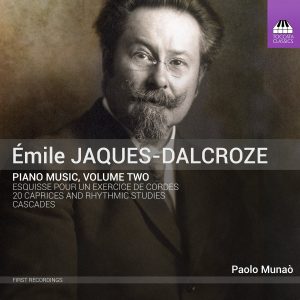
Émile Jaques-Dalcroze Piano Music, Volume Two
The Swiss composer Émile Jaques-Dalcroze (1865–1950) is best remembered for his development of Eurhythmics, which teaches the appreciation of music through movement. But Jaques-Dalcroze, who studied with Delibes and Fauré in Paris and with Bruckner and Fuchs in Vienna, was a considerable composer in his own right, with operas, cantatas and orchestral works among his substantial output. His 20 Caprices and Rhythmic Studies constitute an important but hitherto unknown set of character-studies, combining a relaxed lyricism with technical challenges of considerable subtlety for the player.
Notes en Français
Paolo Munaò, piano
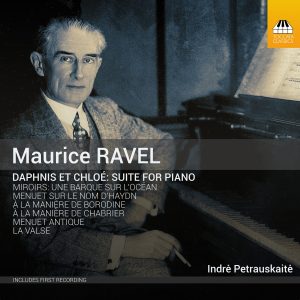
Maurice Ravel: Piano Music
Almost every pianist, it seems, wants to record Ravel, but virtually all of them have overlooked a treasure trove of his solo-piano music: the composer’s short score for Daphnis et Chloé. Some parts of it are unplayable by a single pair of hands, but with judicious arrangement this working draft can be mined for diamonds. Only a handful of musicians have made their own suites for solo piano; here the Lithuanian pianist Indrė Petrauskaitė, carefully observing Ravel’s original textures, has produced something new: a 40-minute concert suite of unsuspected Ravel for solo piano that also respects the dramatic outline of the original ballet. The other, more familiar works here extend the ideas of antiquity and transcription.
Indrė Petrauskaitė, piano
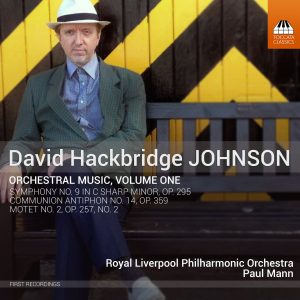
David Hackbridge Johnson: Orchestral Music, Volume One
The English composer David Hackbridge Johnson (b. 1963) has been, until now, one of the best-kept secrets in music, building up a huge catalogue of works completely unknown even within the classical world. Learning the orchestra from the inside, as a player, he has developed a confident and powerful language inherited in part from Brian, Copland, Janáček, Rubbra, Sibelius, Simpson, Tippett and other such masters, capable of bold strokes of colour and gripping dramatic gestures, often informed by a grim sense of humour, all given purpose by a masterly control of long-term symphonic tension.
“This is some of the most exciting new orchestral music that has ever come my way. David writes with complete mastery and meticulous craftsmanship, and above all packs an immense emotional punch.” —Paul Mann
Royal Liverpool Philharmonic Orchestra
Paul Mann, conductor
Rodney Newton’s Spanish Diary
UPDATE: ALBUM AVAILABLE NOW! Day 1, Sunday, 17 September 2017 This afternoon my old friend Martin Anderson and I set out for Málaga to record…